Here is a scan of an old rendering I did around the turn of the century for a house that never got built. I am the last of the great hand drafters. I don't do much hand drafting, presentation drawings or models anymore. Too time consuming and therefore expensive. I don't get many clients willing to pay for that. I still sketch a lot though.
Cross Gambrel
Here is a pic of a house I helped with the structure of. It is quite large and the folks wanted a cross gambrel roof which makes for an interesting structure from an engineering standpoint.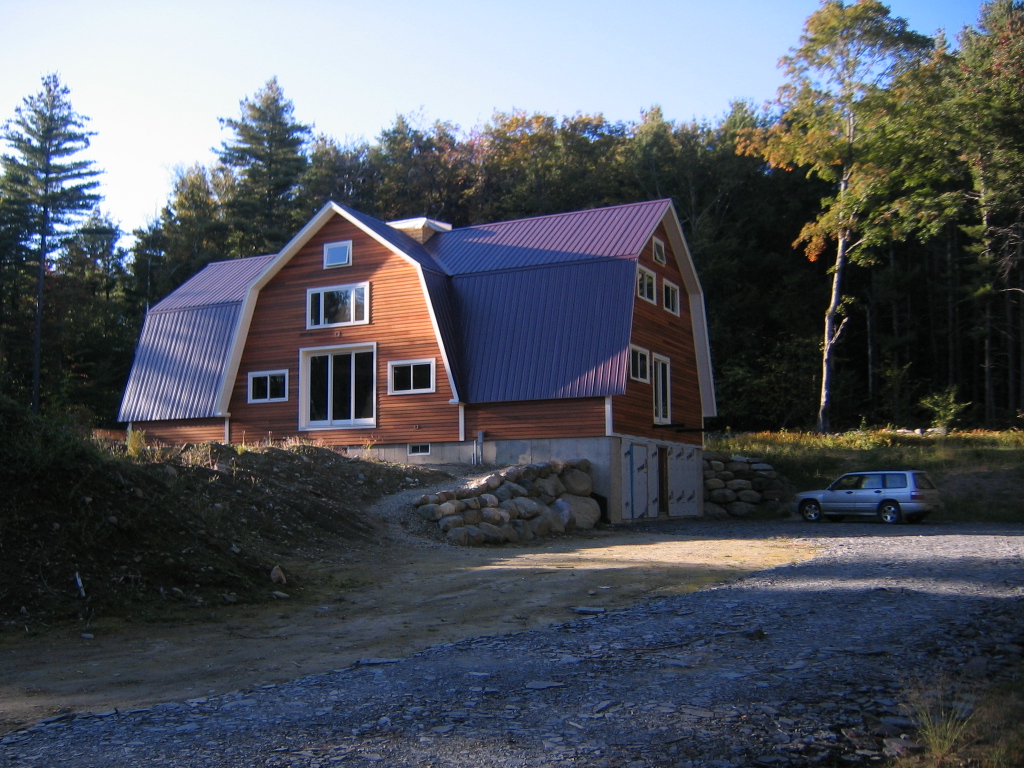 Here is an image from the model showing the cross ties pulling the whole thing together.
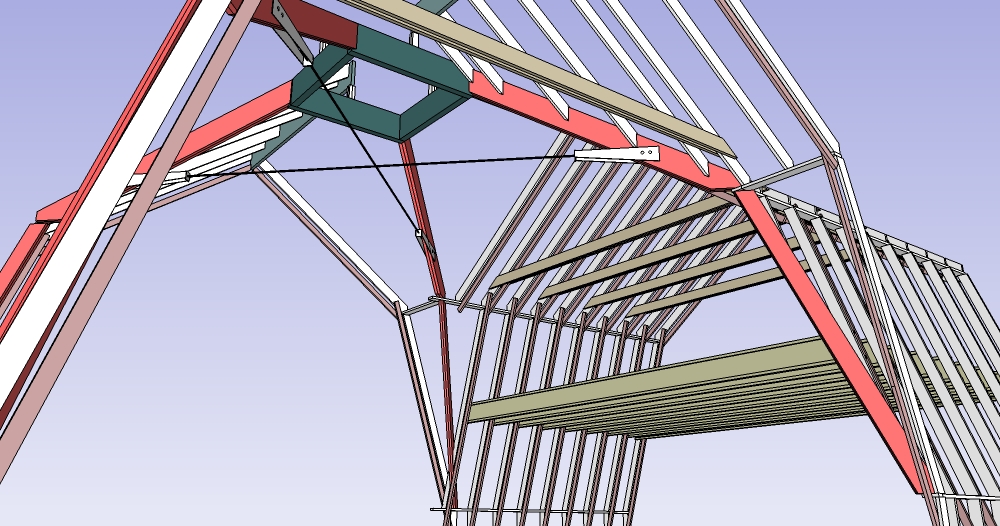 The house kinda looks like the victim of a mudslide but is also rather cool.
A client's addition/renovation process blog
http://musingsfromdave.blogspot.com/Here is a process blog from some folks I helped to design an addition for last winter. It was the sort of project where having an architect payed off (if I remember some of the early schemes they came to me with). We were able to phase the project, and with the help of some very thorough pricing by the contractor, make some big decisions before starting construction. The original house was not unlike my own in size - bigger kitchen and only one bedroom though. They wanted a sunny spot to soak up morning sunshine. I gave them four and labeled them as such on the plans.
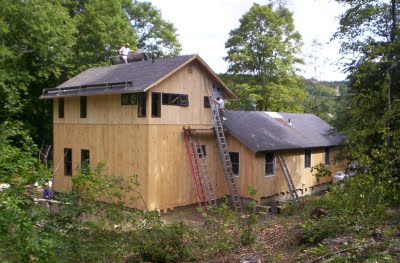
Barn Update - Summer 09
Here is a recent photo of my cool modernist low budget barn. I spent quite a bit of time working on work in the barn this summer. Not so much time working on the barn itself however.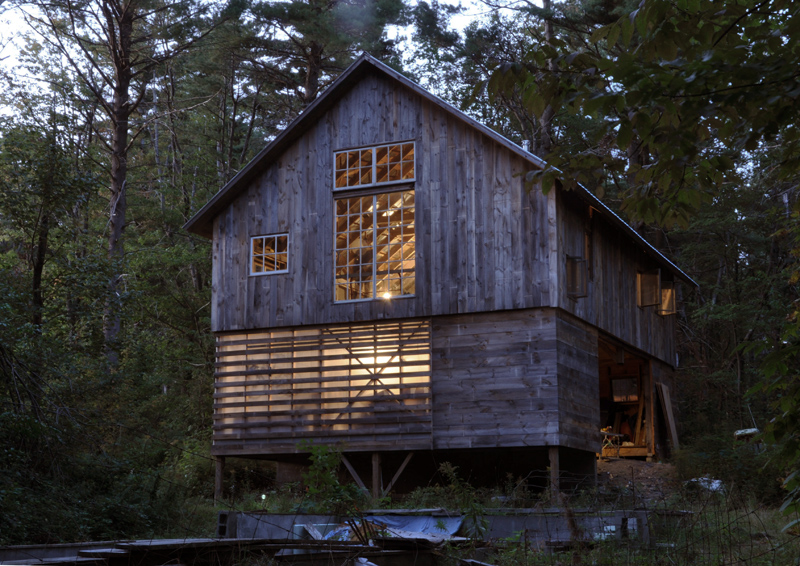
Vermont Mod Farmhouse update
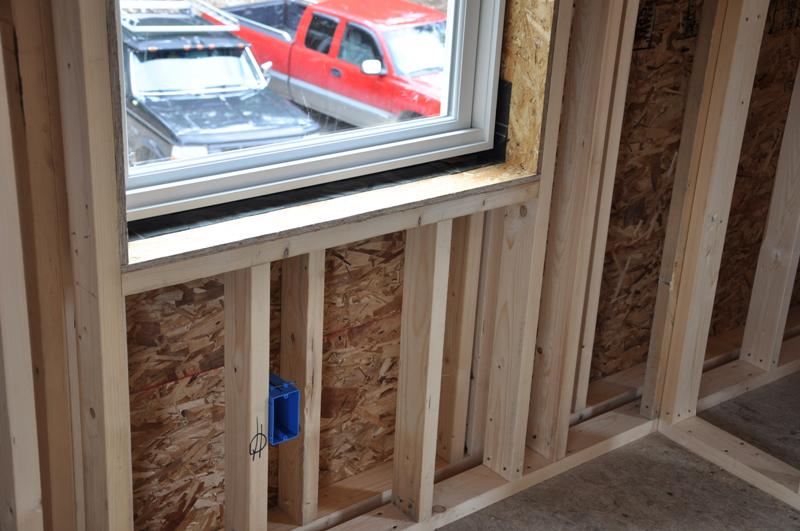
Here are some photos from a recent site visit to the "Vermont Mod Farmhouse" porches and garage are not built yet but from inside you can start to feel the spaces. This project was a good example of what it's all about for me: light, spatial dynamics, simplicity of form and detailing, a much higher level of plan function than the average house, views, night-vs-day perceptions, modern super-insulation and construction materials and methods, all while maintaining a sense of the familiar. 2240 s.f. plus partially finished walk-out basement, 4 bedrooms.


DSIRE - database of incentives
Database of State Incentives for Renewables & Efficiencyalso: Energy Star Efficiency Vermont If you are a builder building an energy star home here is where the government gives you $2000 (why on earth would a builder not utilize the energy star program? ) note to self: Get Steve to write a guest entry about this
Triangles in Kitchens
I have been thinking lately about the work triangle in the kitchen. This was a construct of the 1940’s when men in suits were trying to engineer the function of the kitchen to make women’s lives easier. The work triangle consists of the locations for the storage, preparation and cooking of food. Fridge, sink and stove. The triangle ignores some other important functions such as cleanup, the idea of different types of storage (fridge, dry, long term, short term easy access) Sam’s club (24 packs of paper towel rolls) Also if there are several people working in a kitchen, the triangle may result in conflict. I have sketched my ideal kitchen. It is not for everybody but I have lived and cooked in over a dozen kitchens so I know what I like. I like a large island with a small bar sink for all food prep. A drawer type fridge under the counter is helpful because I like a separate fridge and upright freezer of equal size in a large and very adjacent doorless pantry. (I am a gardener and have lots of frozen food) The pantry allows me to keep things such as my mixer, coffee grinder, pasta maker, food processor, microwave etc. out on a countertop. The island allows me to spread out. Due to my long arms I also like the height of the island to be a few inches lower than the countertops. I like a large cooktop with 6 burners and a good large quiet hood with good lighting. I like a very large deep sink with a tall faucet. When I do my own kitchen someday I will get a restaurant sink and faucet. (foot pedal operated faucet?) I don’t like upper cabinets at all but prefer as much glass as possible over the counter. I also detest corner cabinets and strive to avoid them. A variation on this sketch would be to put wall ovens and a fridge on either side of the cooktop along the outside wall. And perhaps put the sink in the island. This works well if there are no windows over the counter.
too cool to ignore
link to http://savethepinkbathrooms.com/which goes with this http://retrorenovation.com/
facade redesign
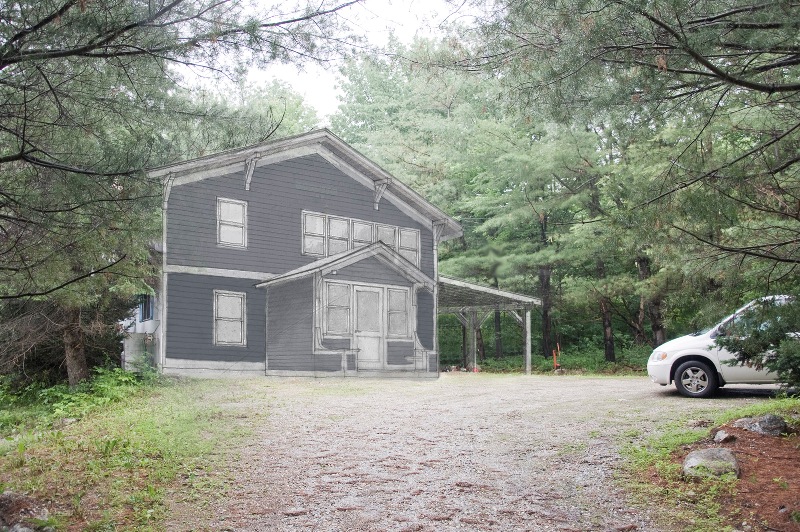
This is a simple project I did entirely in Photoshop after a site visit to take some photos and talk to the owner. The original house needs updating for a number of reasons. Most of what it needs is rather straightforward and shouldn't require an architect. Originally, you entered the door on the ground floor and immediately went up a narrow set of stairs into the living room. I sketched in a vestibule/mudroom to improve the function and experience of entry. The upper wrap-around porch is mostly rotten and unused so I removed it from the image, reconfigured windows and siding and rendered it in a semi-photorealistic way. In locations without stringent building permit applications this is often enough to take to a builder and get started.
non-interesting post
Sorry about this not very interesting post. I was in Maine visiting family for a week and when I got back I had to go into production mode. I have an old large oak desk out in the barn where I have been working occasional nights and weekends without the distraction of the internet. I am hopelessly behind on the winters wood supply and I haven't ridden my bike as much as I would like to lately. I could do some mumbling about not getting paid (why do people always want me to work for free?) or I could grumble about square footage (its all relative and americans are really very spoiled) Or about how the banking and real-estate industries work (again square footage - quantity is 10x more important to your bank than quality)but I won't. Lots of my architecture school classmates are under or unemployed so I can't complain too much.
Western MA eco mod update


Sketchup model in 3-d warehouse
Eastern-vs-Western here in VT
This is something I run into fairly often. I am asked to design a home in a location that has a beautiful view and the client wants every room to have equal share of that view. Oh, and nothing may obstruct that view (trees, porch posts, mullions in windows, other parts of the house). Booooring. It is much more lively and interesting to break up a big view into vignettes so that the various locations in the house have variable relationships with the view. This is much more a part Eastern landscaping philosophy than the Western expansionist ideal. (which often includes random acts of shrubbery) The eastern philosophy says that the view starts at the end of your nose and extends to infinity. It also includes what you don't see but know is there. The Western view is "I need to see as much of the mountains as possible from every room in the house (and outside). Those trees are in the way - off with their heads". Side note: I heard that Tim Burton is working on an "Alice in Wonderland" movie! There should be one spot that takes it all in but this should be a place that you have to go to so the view doesn't become a part of the humdrum of everyday routine. This is just a small philosophical lecture that I usually lose in the end but I thought I'd write it down and file it under "mutterings"
Mailer Campaign
I Just put out an introductory mailer. Click on the image to see. There is a very pretty flash slideshow of images that I produced in Photoshop.
 I realized I am not as well known locally as I would like so I put together a very pretty email campaign.
schematic house video
This is a flythough video I did in Sketchup. It is rather fast so hold onto something
more sketches from the Southern VT cape
an exterior sketch - zoomed in shows the feel and spaces better than zoomed out to get the whole building in. This showed me that there was too much going on on the roof. We may eliminate the first dormer on the left and replace it with an awning window pushed right up to the frieze board. The porch is very deep which brings up light issues in the large room behind it. Thus the small dormer there. The middle dormer is for the m.bedroom. I like to create upstairs bedrooms that feel like treehouses.

Southern VT cape addition
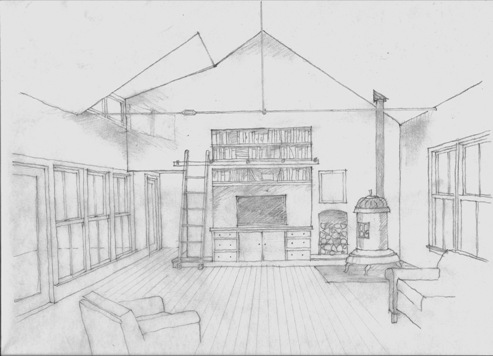
Here is a quick architecty rendering of an interior space in a Southern VT cape addition we are working on. My intern is building a sketchup model from which I am rendering views such as this one. The project is complex enough that the 3-D aspect is neccesary to inform decisions. Having an intern is an eye opening experience. 40 productive hours per week gets a lot done and now I am worried about having enough work to keep him occupied!
links! Tim Prentice and Arthur Ganson
Art. Tim Prentice creates wickedly cool kinetic sculptures and Arthur Ganson creates glorious little mechanisms that do things. Enjoy
NESEA Workshop in Brattleboro
Yesterday I attended a workshop put on by NESEA, the Northeast Sustainable Energy Association entitled "Residential Retrofits for Energy Efficiency and Sustainability" by Larry Harmon. Usually I have to travel to Boston or Burlington to attend these which can be costly and time consuming so it was nice to have one a mile down the road from my offices. There was a lot of good information and Larry is an engaging speaker. The big things that I came away with were the reinforcement of what I have been learning about air sealing, venting, and insulation. 1-Seal completely before adding insulation. - Most contractors or architects probably don't grok the importance or level of thoroughness that is required here or realize the ramifications of doing a less than perfect job. It is not just about energy loss and heating bills. It is very much about how to make a house that will last 100 years or more. There was much discussion and many slides of imperfect air sealing jobs and how they acellerated rot and mold problems.
2-Don't ventilate your roof! That was so 80's and 90's. Now, ten or more years later we get to see the nasty ramifications of venting your roof. yuck!
There was a lot of other information which I may add in here over the next few days and some of which was rather techy involving cost analysis calculations and BTU's and therms, (oh My!)
What disturbed me as it often does at these events is the lack of local builders in attendance. Of the 10% of local builders who care about building science and sustainbility issues, very few will go much further than a subscription to JLC. I'm afraid that if I go out there and draw up plans for a house with an unvented roof or create specifications for enhanced air sealing, builders will simply refuse to follow the plans and convince the homeowners that the architect (me) is full of it. It's an issue that I'm sure a lot of other architects face as well. Although I suspect that 90% of architects don't really care about such things either.
Added the next day in response to a comment.
The presenter showed lots of slides of what happens when you leave a pencil size hole in the sealing of the attic before adding insulation. Basically air pressure turns it into an moisture laden air nozzle. All the moisture then condenses (dew point) on the sheathing and rots it through fast. Or it freezes on the underside of the sheathing then rains down on the insulation when it thaws. Ventilation compounds this pressure effect. The best method seams to be to bypass all these issues and spray the underside of the sheathing with closed cell foam which is what I specify on new construction and treat the attic as conditioned space. Loose fill cellulose or fiberglass batts lose much of their insulating value when exposed to air movement. Many independent tests in recent years have shown the temperature on the underside of the roof does not vary due to ventilation or no ventilation. There were also slides of what happens when insulation is added to an existing house attic that previously had no problems other than high heat bills. Suddenly the attic was cooler, the dew point moved to inside the attic and rot set in almost immediately. board sheathing holds up better than plywood which holds up better than osb.
I get the feeling that as building science matures, ventilated roofs will become a way for architectural historians to date houses to a specific time period in the late 20th century and early 21st century.
Kyu Sung Woo Architects - Putney House
 This is rather cool and local. Unfortunately when high end modern happens around here (rarely) it tends to have a big city architect behind it. I hope to change that. Although to be fair it was for the architect's own family.